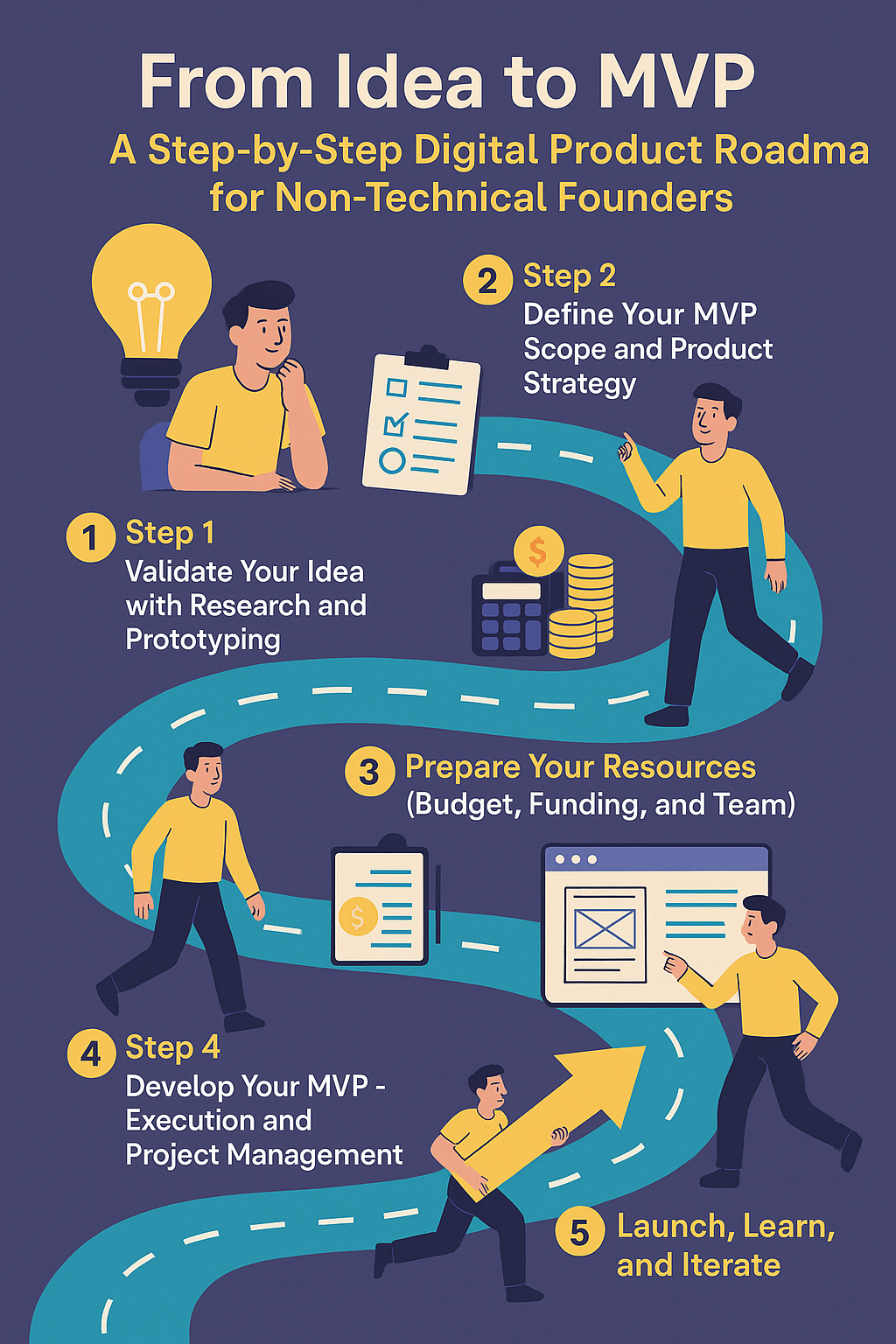
From Idea to MVP: A Step-by-Step Digital Product Roadmap for Non-Technical Founders
It's intimidating to build a tech startup when you can't code. You probably are one of those non-technical founders who do not know where to start. Well, the good news is that everything from this simple idea inside your head to a working MVP in users' hands is covered by this digital product roadmap for non-technical founders. We’ll walk through each step in plain language, so it's easy to follow; almost like a friendly Non-Technical Founder MVP Guide.
Table of Contents
Why does having a roadmap matter? Without a clear plan, non-technical entrepreneurs often feel lost, waste money, or build something nobody really wants. This roadmap will save you from that. We’ll start with startup idea validation and market research to make sure there’s a real need for your product. Then we’ll define exactly what you should build for your MVP and what success looks like. Thereafter, we will talk about how to gather resources and select how to build your product with zero coding skills. Yes, you are even going to learn how to build an MVP yourself without knowing how to code using modern no-code tools or getting the right technical help. Lastly, we will explore launching your MVP to real users and learning from their feedback.
What is an MVP? It stands for Minimum Viable Product; the smallest version of your product that still delivers your core idea’s value. Think of it as a simple first draft of your app or website that real users can try. The goal of an MVP is to test your idea in the world without necessarily having to spend a fortune. You don't need to build a complete product with all features. You only build just enough to see if your solution actually solves the problem for your target audience. This is one of the key parts of the lean startup methodology: build something basic, get it out fast, and learn from real users. As you work your way through this product roadmap step-by-step guide, remember you are not alone. Many successful companies started exactly this way; by building a humble MVP to prove their concept.
Now, let's walk through that journey from an idea to MVP step by step!
Step 1: Validate Your Idea with Research and Prototyping
The first step is all about startup idea validation. It's all about being sure your idea really solves a problem and that real people would want it. That means doing homework ahead of time before building anything:
1.1 Conduct Market Research and Identify the Problem
Start by pinning down the problem your idea solves and who has that problem. You need to research the market need to be sure that it is substantial: how many people have the issue, and how badly do they want a solution? If few people care, then that's a signal to go back to the drawing board before you proceed.
1.2 Analyze Competitors and Existing Solutions
Study the competition. Note both your direct competitors but also any alternative solutions people are using now. Find the gaps; something users need that isn’t being delivered. Those gaps are where your MVP can stand out and offer a unique value.
1.3 Prototype and Test the Concept Early
Before investing in development, create a prototype; a rough version of your product. For example, sketch out screens on paper or with a simple digital tool to make wireframes. You can even use no-code platforms to build a basic interactive demo without coding.
You can also set up a simple landing page describing your idea and see if people sign up or show interest; this is a quick “smoke test” for demand. Most importantly, talk to potential users. Show them the prototype and ask what they think. Do they really have the problem, and does your solution appeal to them? This early user feedback is extremely valuable. It tells you if you’re on the right track and if you have a good problem-solution fit.
1.4 Refine Your Value Proposition
Following your research, finalize what makes your product unique. Write your value proposition-one sentence that describes for whom it is for, what problem it solves, and why it's better than existing options; also known as an "elevator pitch.". Take all that you learned directly from users to help you make this statement sharp and clear.
Now make a Go/No-Go decision. If people are excited about your idea; saying “I need this!” or eagerly signing up; you have validation to proceed. But if it was lukewarm, or some big competitor was already doing the same thing, then it is time to refine your concept or target another niche before investing in development. Hard evidence of interest-an MVP is to test an idea, not just to build in a vacuum.
👉 ORIGIN8 IT offers idea validation workshops and rapid prototyping services to help you test your concept early. Be it market research, competitor analysis, or even interactive mockups that get feedback from users-we can handle it.
Step 2: Define Your MVP Scope and Product Strategy
Immediately after the validation of your idea, now is the time to decide precisely what you are going to build, what is going to constitute part of your MVP, and what is the plan for getting it done. This step in MVP development for startups is quite important because it gives you an opportunity to create some kind of blueprint so that you won't get lost or overwhelmed during the development process.
2.1 Define Success Criteria and Goals
Decide what a “successful” MVP means for you. Set a few specific goals or KPIs; for example, a target number of sign-ups or a percentage of users who complete a key action. Think of these as the measures that will prove your concept is working. Take note of your biggest assumptions-for instance, "users will share the application with friends"-so that you can make sure to test them with your MVP. These goals and assumptions will drive which features you build and what data you track.
2.2 Outline Key User Personas and User Stories
First, define your user and-very importantly-how they'll be using your product. You need to create a basic persona for your user; for example, a busy college student wanting food late at night. Then you should write a couple of user stories-a short description of how that user would use your app in order to solve their problem. Example: "A student opens the app at midnight to order food and gets it delivered in 30 minutes." These help you keep your focus on what the user actually needs to do, which then informs you about what features are truly necessary for the MVP.
2.3 List Core Features and Requirements
Start out with a comprehensive list of all of the things that you could possibly want for your product: the must-haves, the nice-to-haves, the things you know you need, and the things that'd be awesome to have. Take that list and interrogate each of the features: why is this something a user would need? If it's not supporting your core value or testing an important assumption, it's probably not necessary for the MVP. Also note any technical necessities (for example, basic security if you’re handling payments). You're about to cut this list down but it is useful to begin by considering all the things you might want to include.
2.4 Prioritize the MVP Features
Now, whittle down your list in order to make decisions on what features actually make it in. The minimum in MVP means only the core, must-have features that deliver your main value. Identify your one killer feature; the thing your app absolutely must do well and prioritize that above all. Everything that is not essential for that core value can wait for later. It’s better to launch with a product that does one thing great than many things poorly. Cut out the rest (they can always come later). That's how you allow development to be faster and the costs lower. Keep feature creep at bay by reminding yourself: unless it's absolutely necessary to solve the primary problem or validate a key assumption, it doesn't make the MVP.
2.5 Create a Prototype or MVP Mockup for Feedback
It pays to first visualize how this MVP would look and feel, rather than diving into full development. Create a simple storyboard or high-fidelity mockup of the user flow - just how somebody will navigate your app. You can do it in a design tool or even just draw it out on paper. Then, have a few people walk through this mockup. Observe if they understand how to use it or if they get hung up anywhere. This quick usability test can catch confusing parts early before you spend money building the real thing.
By the end of this stage, you should clearly know what you are building, for whom you are building it, what features will be included, and what success will look like. Now, finally, it's time to bring that plan to life!
👉 Need help with planning your MVP? An experienced product partner can save you a lot of effort here. ORIGIN8 IT helps founders prioritize features and design user-friendly prototypes to set a solid foundation.
Step 3: Prepare Your Resources (Budget, Funding, and Team)
Now, when your plan is on paper, you are going to want some resources that will be needed to execute it. In this step of the digital product roadmap for non-technical founders, you will figure out how much it is going to cost and how you will pay for it, and who actually is going to build this product for you. That is, you set up a budget, plan funding and put together a development team.
3.1 Determine Your MVP Budget and Timeline
First define how much you can spend, and how long you'll give yourself to build the MVP. Be realistic and clear. Create a simple budget that includes design, development, testing and maybe a bit for marketing the launch, plus a buffer for surprises. Then create a rough timeline of development - for example, build the MVP in about 2-3 months. A short timeline keeps you focused on the must-haves, and prevents the project from going on forever. If you've got a hard deadline - say, some seasonal event, or an investor demo day, then be prepared to cut features to hit the deadline. It’s better to launch a smaller product on time than a bigger product very late.
3.2 Plan Your MVP Funding Strategy
There are a few ways to fund your MVP:
- Self-funding (Bootstrapping): Invest your own money. No loss of control, but you assume all the risk and budget is limited.
- Grants/Competitions: Free money if you can get it (no equity loss), but it’s competitive and slow.
- Loans: Borrow money you must pay back with interest. You keep ownership, but you carry debt and repayment pressure.
- Angel Investors/VCs: Raise capital from investors in exchange for equity. You get a lot of funds (and maybe advice), but give up partial ownership and have to show fast growth.
- Crowdfunding: Get small amounts from many people (e.g. via Kickstarter) by pre-selling your idea. Can also prove market interest, but running a campaign takes effort and success isn’t guaranteed.
Many founders start by bootstrapping to build the MVP, then seek investors once they have some user traction. Choose the funding mix that fits your situation and comfort with risk.
3.3 Choose the Right Development Approach
As a non-technical founder, you have a few ways to actually build your MVP. Each approach has pros and cons:
- No-Code/Low-Code: Build it yourself using no-code platforms. It’s fast and cheap, but customization is limited and these tools might not handle complex features or scale well.
- Technical Co-Founder: Partner with someone technical (often in exchange for equity). You get a committed tech ally, but it can be hard to find the right person and you’ll share ownership.
- Freelancers: Hire independent developers/designers to build parts of the MVP. This can be cost-effective and flexible, but you’ll have to manage the project closely, and quality can vary by person.
- Software Development Agency: Hire a company (like ORIGIN8 IT) to build the MVP for you. You get an experienced, all-in-one team to handle design, coding, and testing. It’s the most hands-off option for you, but also the most expensive. The key is to choose a reputable agency so you get quality results.
Step 4: Develop Your MVP - Execution and Project Management
Now you have a plan and a team, it’s time to build! As a non-technical founder, you will oversee the project and ensure things stay on track. Here’s how to manage development and get to launch smoothly:
4.1 Adopt an Agile, Lean Development Process
Work in small pieces, in fast cycles, rather than trying to build everything at once. In other words, agile development is about breaking up the work into short sprints where a team builds a few features at a time. At the end of the sprint, review what's built and gather feedback. That's the Build-Measure-Learn cycle in action: build a piece, measure the results or feedback, learn and adjust. Get the core working before adding fancy extras. The reason is you want to get a basic product that testers can start using as soon as possible.
4.2 Project Management and Communication
Even if you are not coding yourself, it is your job to keep the project organized. Set clear milestones and deadlines for each phase in development. Use a simple project-tracking tool or checklist to monitor progress. Have quick, regular check-ins-at least once a week-with your developers. The check-ins should be where the team shows you what has been done. Regular meetings catch issues early and help keep everyone accountable. Make sure from day one you have access to the code repository so you own the code being written. Encourage open communication: ask your tech team to raise questions or problems right away so nothing festers in silence.
4.3 Ensure Quality Assurance (QA) and Testing
Test as you go, rather than just at the end. Try things out as soon as they are built. Don’t wait until everything is “done” to start finding bugs. Do a small beta test with a few users before the public launch, if at all possible. They can help find issues and tell you what's confusing. Make fixing critical bugs a priority. Check if the MVP is not appallingly slow, too, and user data handling is done in a secure manner. You don't need military-grade security for an MVP, but you should care about user privacy and make sure the app basically works as intended without crashing.
4.4 Prepare for a Smooth Launch
Launching an MVP is less intense than launching a full product, but a little preparation goes a long way. First of all, make sure you have a means of collecting user feedback-something like an in-app feedback form or simply an email contact. Set up basic analytics tools, like Google Analytics or Mixpanel, so you can keep track of what users do inside the app. It is data that will be super valuable to you later. Ensure your hosting or servers can handle the small scale of an MVP (most cloud services can handle your first users easily). Get ready with a simple landing page, or website update, to let visitors know your MVP is live. Also, plan how to support users. Get an e-mail address and/or chat channel ready where they can ask questions or report bugs when they start using the product. Covering these bases, launching your MVP will be smooth and leave a great impression.
Step 5: Launch, Learn, and Iterate
This is the last step on your digital product roadmap for non-technical founders-to launch your MVP out into the wild and learn from real users.
Your MVP is built and tested; congratulations! Now it’s time to put it in the hands of real users and gather learnings for the next steps of your startup journey.
5.1 Launch Your MVP to Early Adopters
When you release your MVP, it’s best to start small. Maybe do a soft launch to a handful of friendly users or a small group of early adopters. Tell them this is an early version and that you welcome their feedback. Starting low-key helps you catch last-minute issues without the spotlight of a big launch. Once things are stable, you can expand your marketing and invite more users. Always be available to support your early users and thank them for their time.
5.2 Collect User Feedback and Usage Data
The whole reason to build an MVP is to learn, so actively seek out feedback. Encourage your early users to share their thoughts. You can send a short survey, ask for reviews, or personally reach out to a few users for a quick chat. Pay attention to what they liked, what frustrated them, and what they wish it could do. This qualitative feedback shows you how well your solution is solving the problem and what to improve.
At the same time, study your usage data. How many people signed up? Are they coming back regularly (i.e., what’s your retention)? Which features are they using most? For instance, if lots of people sign up but very few return the next week, that’s a red flag about retention. Focus on the key metrics that align with the success criteria you set back in Step 2 and watch them closely. (Compare these numbers to the goals you set earlier to see if your MVP is meeting expectations.)
5.3 Iterate and Improve
Armed with feedback and data, start making improvements. Prioritize the issues or feature requests you heard. Often, you’ll find a few quick fixes (maybe a bug or a small UI tweak) that can make users much happier; do those first. For bigger changes, make a list and decide what’s critical vs. what can wait. Continue following the Build-Measure-Learn approach: make a change, release an update, then see if it had the desired effect. Keep your changes incremental; there’s no need to suddenly stuff in a bunch of new features. It’s better to refine the core product based on actual user input. And be open-minded: if feedback shows your initial idea missed the mark in some way, be willing to adjust or pivot. That’s all part of the startup journey.
5.4 Plan for Scaling and Next Steps
If your MVP is a success; users love it and your metrics look promising; start thinking about the future. Think about what Version 2.0 will include; maybe features you initially left out. Also plan for technical scalability: you might need to enhance your infrastructure or refactor some code to support more users. On the team side, consider if you need to hire more developers or even a CTO to take charge of technology as you grow. If you used outside help (agency or freelancers), plan how to smoothly transition or continue development as you scale.
Now that you have a working MVP and some traction, you might seek additional funding to scale. Investors will be much more interested once you can show that real users love your product.
Through all this, keep your product roadmap updated. Your MVP was Phase 1. Now outline Phase 2 based on what you’ve learned. This continuous planning is why product development is a cycle, not a one-time project.
Conclusion
Taking an idea and building a Minimum Viable Product out of it is an exciting journey, especially for a non-technical founder. It may seem daunting at first, but by following this step-by-step digital product roadmap for non-technical founders, you can navigate the process with confidence. We went from thorough idea validation to careful MVP scoping, smart resourcing, agile development, and continuous iteration. Each step is designed to reduce risk and ensure you’re building something people truly want. This comprehensive approach will help you avoid common pitfalls (like spending a fortune on features nobody uses) and keep you focused on solving the core problem for your users.
By starting small, staying customer-focused, and being ready to learn and adjust, you are setting the stage for long-term success. Remember that every big startup; from Airbnb to Instagram; began as a simple MVP. They listened to users and improved over time, and you can do the same. Now you have a digital product roadmap for non-technical founders to follow, so you can go from idea to MVP without getting lost. All that’s left is to take action.
👉 If you’re ready to build your MVP or need expert help at any step, Origin8 IT is here for you. We specialize in MVP development for startups and full-cycle product development. Let’s bring your great idea to life. Get in touch with us today and jumpstart your startup’s journey from idea to reality!